近日,杭州市北京航空航天大学国际创新研究院(北京航空航天大学国际创新学院)医工交叉科创中心硕士生马启睿在力学领域国际期刊《Acta Mechanica Sinica》(JCR Q1, IF=4.6)发表题为“Near-physiological fatigue behaviors of orthopedic implants in vitro”的综述论文。论文系统梳理了骨植入体近生理疲劳行为的体外研究进展,围绕体外测试系统构建、关键表征方法、主要影响因素及作用机制进行了综述,并对未来多因素耦合模拟平台的发展方向进行了展望。医工交叉科创中心硕士生马启睿为论文第一作者,中心助理教授黄慧雯为论文通讯作者,北航国新院为第一完成单位。
原文链接:https://link.springer.com/article/10.1007/s10409-025-25498-x
Recently, Qirui Ma, a graduate student at the Medical Engineering & Engineering Medicine Innovation Center of the Hangzhou International Innovation Institute, Beihang University, published a review article entitled “Near-physiological fatigue behaviors of orthopedic implants in vitro” in Acta Mechanica Sinica (JCR Q1, IF = 4.6), an international journal in the field of mechanics. This paper systematically reviews recent in vitro research progress on the near-physiological fatigue behavior of orthopedic implants, focusing on the construction of in vitro testing systems, key characterization methods, major influencing factors, and underlying mechanisms, and also looks ahead to the future development of multi-factor coupled simulation platforms. Qirui Ma is the first author of this paper, Huiwen Huang, assistant professor at the center, is the corresponding author, and the Hangzhou International Innovation Institute, Beihang University, is the first affiliated institution.
Original link: https://link.springer.com/article/10.1007/s10409-025-25498-x
研究背景
Research Background
骨植入体的疲劳性能是决定其临床服役寿命和可靠性的关键因素。论文指出,骨植入体在体内长期处于复杂生理环境中,不仅要承受肌骨系统产生的循环载荷,还会受到体液环境以及周围组织修复过程的共同影响。传统体外疲劳测试与骨植入体的真实服役环境仍存在明显差距,因此,建立更接近人体真实生理环境的体外评测体系,对于准确预测骨植入体疲劳寿命、指导结构优化设计具有重要意义。
Fatigue performance is a critical factor influencing the clinical service life and reliability of orthopedic implants. This review points out that, after implantation, orthopedic implants remain in a complex physiological environment, where they are subjected not only to cyclic loads generated by the musculoskeletal system but also to body-fluid corrosion and the regeneration of surrounding tissues. There is still a significant gap between conventional in vitro fatigue testing equipment and the actual service environment of orthopedic implants. Therefore, the development of near-physiological in vitro testing systems is essential for accurately predicting the fatigue life and guiding the structural optimization of orthopedic implants.
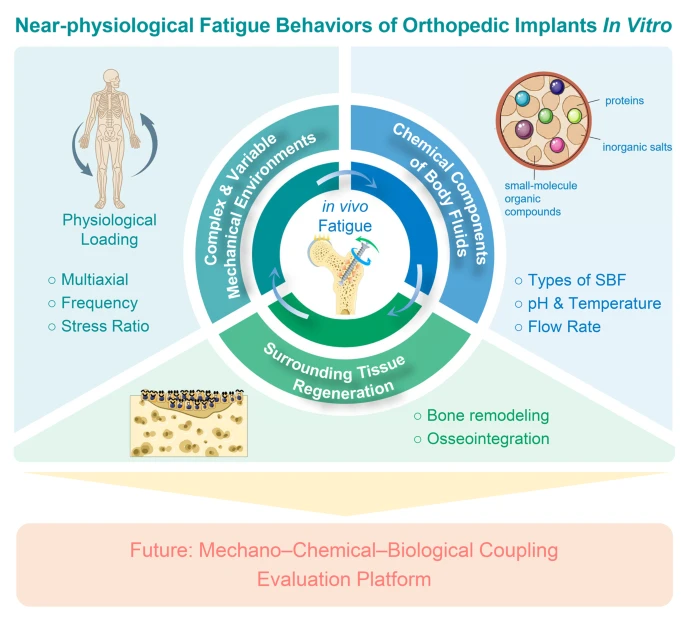
图1 图文摘要
Fig. 1 Graphical abstract
核心成果
Core Achievements
论文系统总结了骨植入体近生理疲劳行为体外研究的主要进展。首先梳理了近生理疲劳测试系统的构建思路,这类系统通常结合动态力学加载装置、模拟体液环境、恒温控制和循环系统,用于更接近真实人体生理环境地评估植入体疲劳行为。论文指出,骨植入体在体内实际承受拉伸、压缩、弯曲、扭转等复杂多轴载荷,不同植入部位和器械的受力模式也存在差异,因此需要建立更贴近真实生理环境的加载方式,以提高疲劳寿命预测的准确性。
This review systematically summarizes the main progress in the in vitro studies on the near-physiological fatigue behaviors of orthopedic implants. Firstly, the construction strategies of near-physiological fatigue testing systems are reviewed, which usually integrate dynamic mechanical loading, simulated body-fluid environments, temperature control, and circulation modules to better reproduce the in vivo service conditions of implants. The review further emphasizes that orthopedic implants are subjected to complex multiaxial loads, including tension, compression, bending, torsion, and their combinations in the body. The loading patterns of different implant are various. Therefore, a loading method that is closer to the real physiological environment needs to be established to improve the accuracy of fatigue life prediction.
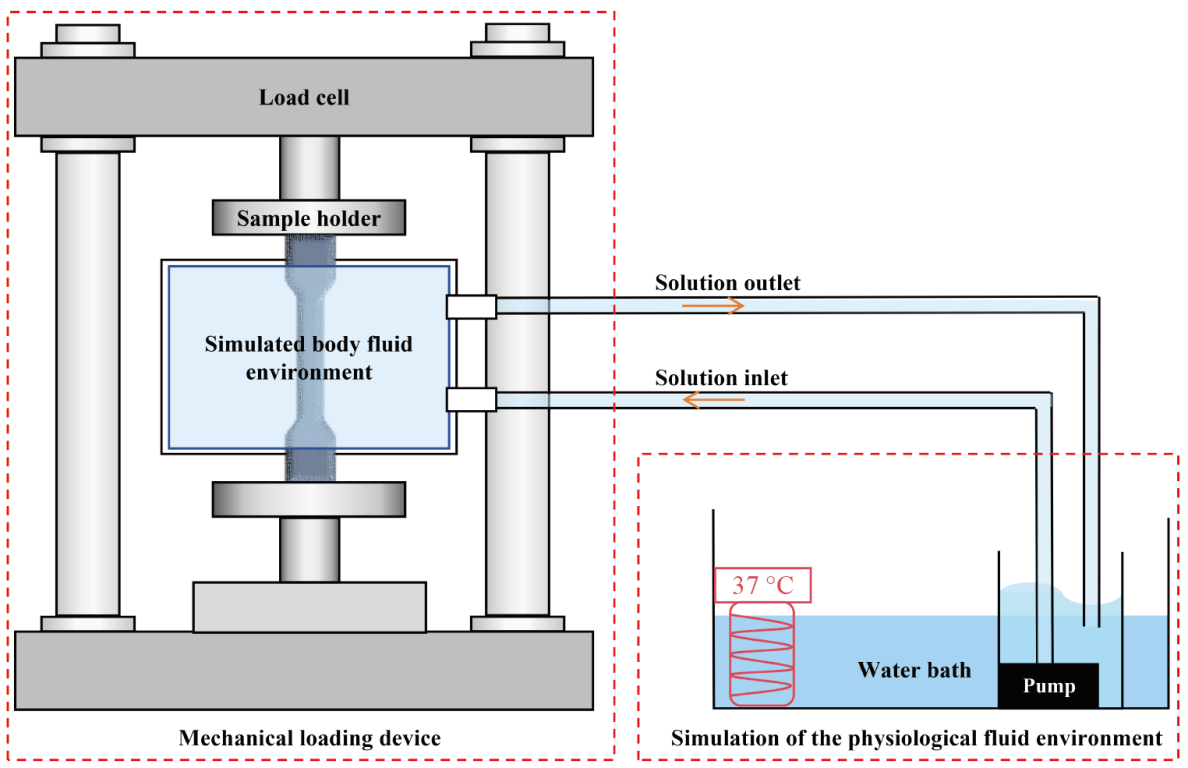
图 2 近生理骨植入体疲劳行为体外测试系统示意图,包括动态力学加载装置、模拟体液环境、恒温控制与循环系统。
Fig. 2 Schematic illustration of the in vitro testing system for assessing the near-physiological fatigue behavior of orthopedic implants, including dynamic mechanical loading, simulated body-fluid environment, temperature control, and circulation modules.
此外,论文梳理了 Ringer's 溶液、PBS、SBF、HBSS 及 DMEM 等多类模拟体液体系,指出体液成分、pH、蛋白质、葡萄糖、离子组成以及流动状态等因素都会显著影响植入体的腐蚀疲劳行为。文章还总结了疲劳寿命、断口形貌、裂纹扩展速率、残余应力和材料降解速率等常用评价指标,为理解骨植入体在近生理条件下的失效机制提供了重要依据。
This review also summarizes various types of simulated body fluids commonly used in fatigue studies, including Ringer's solution, PBS, SBF, HBSS, and DMEM. It points out that fluid composition, pH, proteins, glucose, ionic concentration, and flow conditions all markedly influence the corrosion-fatigue behaviors of implants. In addition, this review outlines common evaluation indicators such as fatigue life, fracture morphology, crack growth rate, residual stress, and material degradation rate, providing important basis for understanding the failure mechanism under near-physiological conditions.
表1 骨科植入物近生理疲劳测试中常用模拟体液类型及其特性
Table 1 Types of simulated body fluids commonly used in near-physiological fatigue testing of orthopedic implants and their characteristics

从机制层面看,论文指出骨植入体近生理疲劳失效本质上是力学、化学和生物因素共同作用的结果。在循环载荷与腐蚀环境耦合作用下,金属植入体表面的钝化膜会反复经历破裂、溶解与再钝化过程,从而促进腐蚀疲劳裂纹萌生与扩展。同时,周围组织再生与骨整合能够改善植入体内部应力分布,在一定程度上提升其疲劳抗力。
This review points out that the near-physiological fatigue failure of orthopedic implants is essentially the result of coupled effects of mechanical, chemical, and biological factors. Under the coupling effect of cyclic loading and corrosive environment, the passive film on metallic implant surfaces repeatedly ruptures, dissolves, and repassivates, thereby promoting the initiation and propagation of corrosion-fatigue cracks. At the same time, surrounding tissue regeneration and osseointegration can improve the stress distribution within the implant to enhance its fatigue resistance.
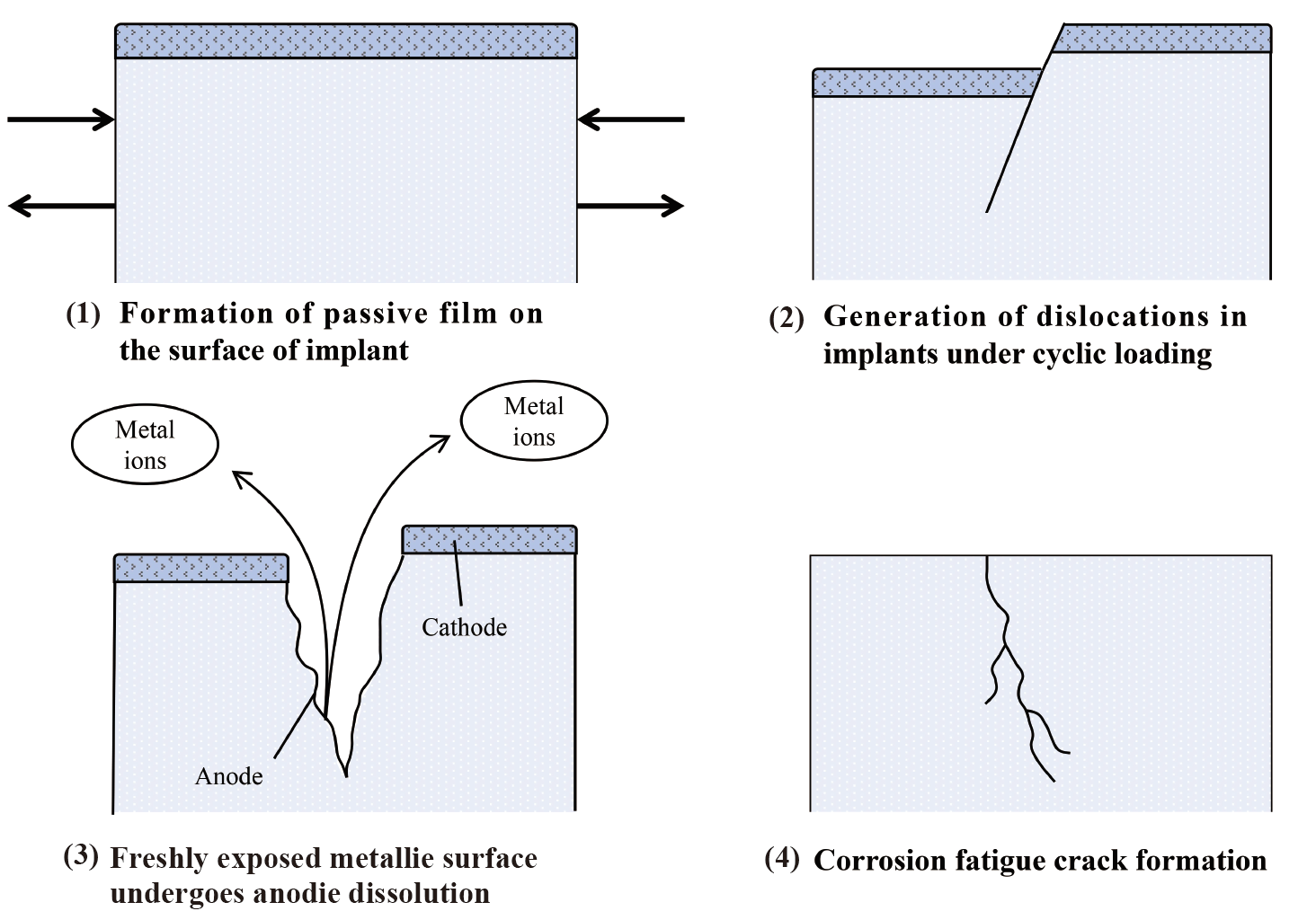
图 3 循环载荷作用下骨植入体腐蚀疲劳裂纹形成机制示意图,包括钝化膜形成、位错产生、阳极溶解及裂纹形成等过程。
Fig. 3 Schematic diagram of corrosion-fatigue crack formation in orthopedic implants under cyclic loading, including passive-film formation, dislocation generation, anodic dissolution, and crack formation.
总结
Summary
论文认为,现有研究已初步揭示力学、化学和生物因素对骨植入体近生理疲劳行为的影响规律,为建立拟真度更高的体外评价体系奠定了基础。但当前测试系统在复杂多轴载荷模拟、真实体液环境重建以及骨组织再生与骨整合过程模拟方面仍存在不足。未来应重点发展力学—化学—生物多因素耦合的近生理体外模拟平台,实现复杂载荷、动态体液循环和组织再生过程的一体化模拟,为骨植入体的性能优化与临床转化提供更可靠支撑。
This review concludes that current studies have preliminarily clarified the influences of mechanical, chemical, and biological factors on the near-physiological fatigue behaviors of orthopedic implants, providing a foundation for more realistic in vitro evaluation systems. However, existing testing systems still have limitations in complex multiaxial loading, body-fluid environments, and modeling bone regeneration and osseointegration simulation. Future work should focus on developing mechano-chemical-biological coupled near-physiological in vitro systems that enable the simulation of complex multiaxial loading, dynamic fluid circulation, and tissue regeneration, thereby providing more reliable support for the performance evaluation, optimization and clinical translation of orthopedic implants.
图片:马启睿
文字:马启睿