北航国新院医工交叉科创中心提出多代理模型用于拉胀骨钉性能预测新方法,成果发表于力学领域知名期刊《Composite Structures》(JCR Q1, IF=7.8),助理教授黄慧雯为论文第一作者,中心主任王丽珍教授为通讯作者。北航国新院为第一完成单位。
原文链接: https://www.sciencedirect.com/science/article/pii/S0263822326006173?via%3Dihub
A novel approach for efficient property prediction of auxetic bone screw was developed by The Medical Engineering & Engineering Medicine Innovation Center of the Hangzhou International Innovation Institute of Beihang University. The full research paper was published in Composite Structures (JCR Q1, IF = 7.8). Assistant professor Huiwen Huang is the first author. Professor Lizhen Wang, director of the center, is the corresponding author. Hangzhou International Innovation Institute of Beihang University is the first affiliated institution.
Original link: https://www.sciencedirect.com/science/article/pii/S0263822326006173?via%3Dihub
研究背景
Research Background
内凹角拉胀多孔骨钉通过负泊松比效应增强钉-骨锚固,其多孔结构可有效降低应力遮挡、促进骨长入,但也会引发应力集中、削弱承载能力。壁厚(t)、内凹角度(α)和支撑筋宽度(w)协同调控孔隙率、泊松比、弹性模量和极限强度。单一指标优化难以兼顾力学可靠性与成骨活性,亟需建立“设计变量–多特性响应”映射模型,实现拉胀骨钉性能的快速预测与多目标优化(图1)。
Re‑entrant auxetic porous bone screw can enhance screw‑bone anchorage via its negative Poisson’s ratio effect, with the porous structure reducing stress shielding and promoting bone ingrowth. However, porous structure introduces stress concentration and compromise load‑bearing capacity. The thickness, re-entrant angle, and strut width of re-entrant unit synergistically regulate the porosity, Poisson’s ratio, elastic modulus, and ultimate tensile strength of auxetic bone screw. It is insufficient to simultaneously achieve mechanical reliability and osteogenic activity by single design variable and property optimization. Therefore, it is essential to establish quantitative mapping between design variables and multiple properties to enable rapid prediction and multi‑objective optimization of auxetic bone screw (Fig. 1).
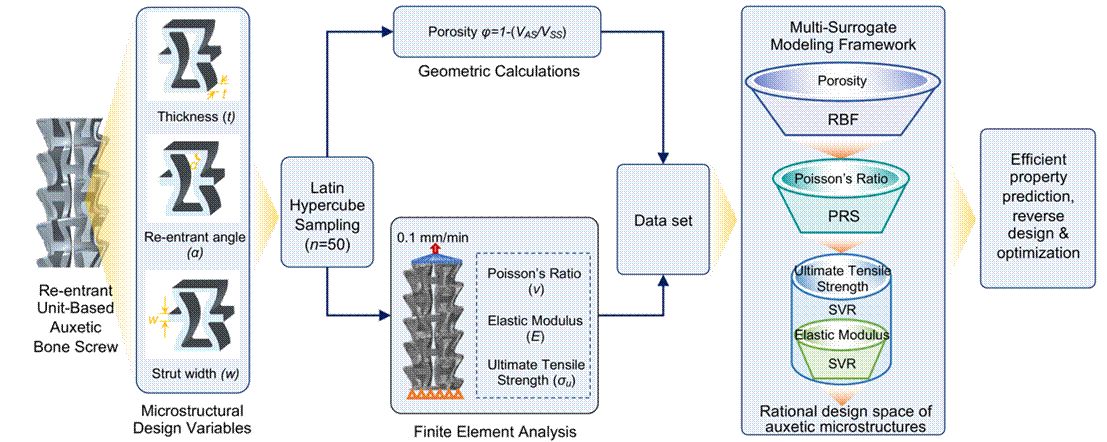
图1 研究总览
Fig. 1 Overview of the research
核心成果
Core Achievements
围绕内凹角拉胀单元的三个关键设计变量——壁厚(t)、内凹角度(α)和支撑筋宽度(w),本文采用拉丁超立方采样生成50组设计方案,并结合有限元分析获得对应的孔隙率、泊松比、弹性模量和极限拉伸强度性能数据,形成多性能响应数据库。
Using Latin Hypercube Sampling, 50 auxetic bone screw samples were generated based on three critical design variables: thickness (t), re-entrant angle (α), and strut width (w). The porosity, Poisson’s ratio, elastic modulus and ultimate tensile strength of 50 samples were obtained through geometric calculations and finite element analysis (FEA) to create a multi-property dataset.
本研究比较了Kriging、响应面模型(PRS)、径向基函数(RBF)、支持向量回归(SVR)和随机森林(RF)五类代理模型在小样本条件下的预测能力。不同性能指标的最优预测模型不同,其中RBF模型对孔隙率预测性能最佳(R⟡=0.956, RMSE < 0.01),带交互项的二次PRS模型对泊松比预测效果最佳(R⟡=0.943, RMSE = 0.14),SVR模型对弹性模量(R⟡=0.961,RMSE = 2.51)和极限拉伸强度预测能力最优(R⟡=0.977,RMSE = 15.62)。据此建立拉胀多孔骨钉基本力学性能的自适应多代理模型框架(图2)。
Five types of surrogate models–Kriging, Polynomial Response Surface (PRS), Radial Basis Function (RBF), Support Vector Regression (SVR), and Random Forest (RF)–were constructed and compared for each property prediction. The optimal models were RBF for porosity (R2 = 0.956, RMSE < 0.01), quadratic PRS with interactions for Poisson’s ratio (R2 = 0.943, RMSE = 0.14), and SVR for both elastic modulus (R2 = 0.961, RMSE = 2.51) and ultimate tensile strength (R2 = 0.977, RMSE = 15.62). A response-adaptive multi-surrogate modeling framework was developed for efficient property prediction of auxetic bone screw (Fig. 2).
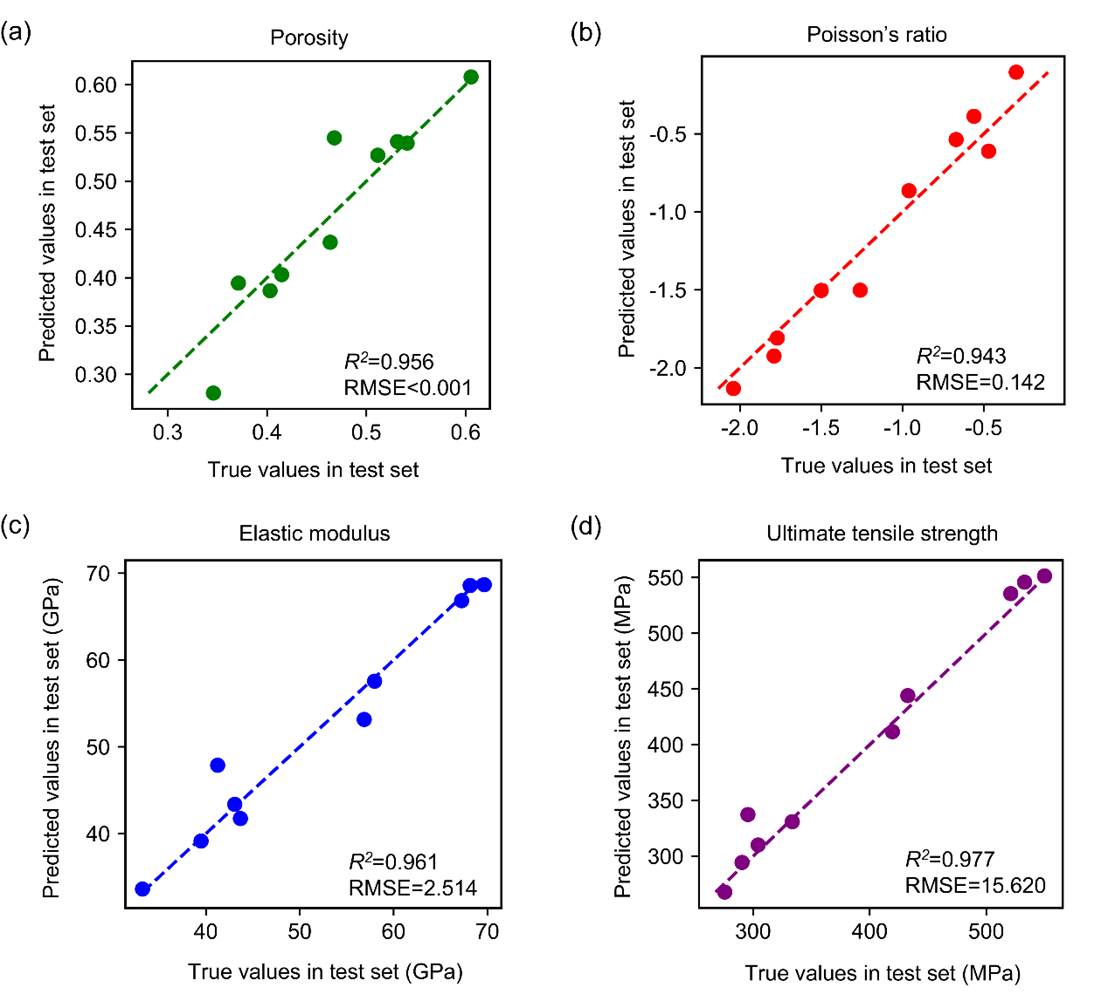
图 2 拉胀骨钉各项性能最优代理模型的预测一致性图。(a)基于RBF模型的孔隙率预测;(b)基于PRS模型的泊松比预测;(c)基于PRS模型的弹性模量预测;(d)基于SVR模型的极限拉伸强度预测。
Fig. 2 Parity plots of the best surrogate model for each property of auxetic bone screw. (a) RBF for porosity prediction; (b) PRS for Poisson’s ratio prediction; (c) PRS for elastic modulus prediction; (d) SVR for ultimate tensile strength prediction.
本文提出拉胀骨钉微结构设计参数的调控策略(图3):第一步,利用RBF快速剔除孔隙率不达标区域,同时用PRS将泊松比约束至目标区间;第二步,对剩余候选点,用SVR评估弹性模量是否适配骨组织,并将极限抗拉强度作为强约束优先满足;第三步,在在满足前两步的候选集中,选取对t、α、w变化不敏感的区域作为推荐解。该策略将多响应权衡转化为明确的筛选顺序和约束形式,避免单指标优化带来的刚度或强度风险,为后续帕累托多目标优化界定合理设计空间。
This study proposed an executable microstructural design variables regulation strategy for auxetic bone screw (Fig. 3). First, the RBF could be used to rapidly filter out design variable combinations with unsatisfactory porosity. Concurrently, the PRS could be employed to constrain the Poisson’s ratio of the candidate design variable combinations within the target interval. For the remaining design variable combinations, SVR could be used to assess whether the elastic modulus matches that of bone tissue. The ultimate tensile strength should be as a hard constraint because it is more sensitive to failure modes. After meeting the above objectives and constraints, recommended solutions could be selected from regions that are insensitive to perturbations in design variables. This strategy converts multi‑response trade‑offs into a clear screening sequence and constraint hierarchy, avoiding the risks of single‑objective optimization and providing a well‑defined design space for future Pareto‑based multi‑objective optimization.
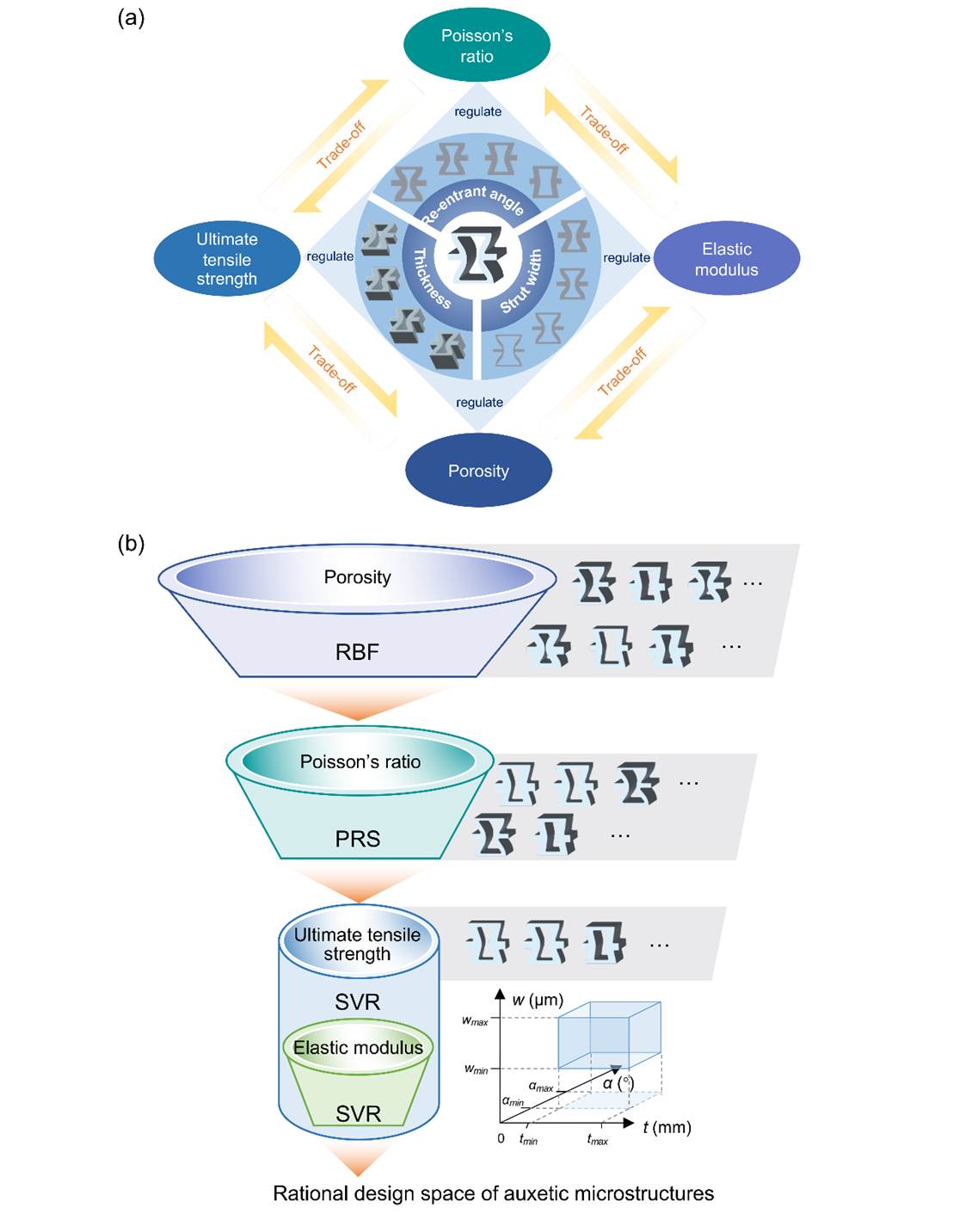
图 3 拉胀骨钉微结构设计参数的调控策略。(a) 拉胀微结构设计的权衡;(b) 拉胀微结构设计变量控制策略。
Fig. 3 Design variables regulation strategy for auxetic bone screw. (a) Trade-offs in the microstructural design of auxetic bone screw; (b) Variables control strategy for microstructural design of the auxetic bone screw.
总结
Summary
本研究建立了“微结构设计变量—多性能响应”的定量映射与多代理预测框架,在小样本下兼顾精度与可解释性,为拉胀骨钉性能的高效预测、逆向设计和优化提供了计算工具。未来应结合多目标优化算法,进一步平衡锚固能力、力学适配、承载能力与成骨活性等多重目标。
This study established a quantitative mapping approach between microstructural design variables and multi-property responses, along with a response-adaptive multi-surrogate modeling framework which balanced high-precision prediction with interpretable representation under small‑sample conditions. It offers a computational tool for efficient prediction, reverse design, and optimization of auxetic bone screws. Future study should incorporate with multi-objective optimization strategies to achieve a balance among screw-bone interfacial anchorage, biomechanical compatibility, load-bearing capacity, and osteogenic activity.
图文:黄慧雯